"I love talking about nothing. It's the only thing I know anything about." - Oscar Wilde

Pages

Showing posts with label geeky stuff. Show all posts

Tuesday, 11 September 2012

Uglies series - Scott Westerfeld

Right, so I know I haven't reviewed a book in over a month, and I know I'm supposed to be a Literature student, and I know that's terrible blah blah blah. But I have actually read four books in the intervening time - now alright, so the Uglies series isn't exactly Dostoyevsky (you know, I spelt that right first time. I should definitely get points for that), but I have been working full time, and the resulting self pity eats up my time. Anywho....

Uglies
One of the things I liked the most about this series, but this book in particular, was the character of Tally, who is one of the most convincing teenage heroines I've read in a YA fantasy book. There are three really interesting blogs on Bookish Blather about how Tally is actually much more of a 'feminist' heroine than The Hunger Games' Katniss Everdeen, despite generally kicking less ass. Anyway, the pacing was also really good - it kept you interested without throwing too much at you too fast, and I think the idea (see the TV Tropes or goodreads page for full details) is fascinating, particularly with the current societal attitude towards femininity in relation to beauty, and falsity.

Sorry, that went a bit pretentious. I'm going to have one more moment of snobbery, then get a little perspective - just bear with me. I couldn't point to specific examples of why, but the friendship between Tally and Shay was just missing something. Also, what is it with YA fantasy protagonists and whining?

***/*

Pretties - goodreads
I  found the friendship element better in this book, and I also found the whole trading-in-for-a-new-love-interest thing a lot less irritating than it usually is (in fact, this series plays the love-triangle theme with less oh-for-Christ's-sakes than most of the other YA series which feel the need to chuck one in). I also thought the Cutters were a skilful navigation of a very touchy subject in a fantasy context - similarly to the theme of the series generally.

What I did find slightly annoying was that it seemed to back up on the message of Uglies. I know that's kind of deliberate, I just didn't feel like we'd got very far. Also, the whole Andrew Simpson Smith caveman bit was kind of out-of-left-field (at the time I thought it might become relevant, and therefore less random, as the series went on, but...it didn't).

***

Specials - goodreads
I preferred this to Pretties, I think, because it pulled back some of the excitement from the first book. Of course, apocalyptic storylines will do that. The romantic subplot in this is also much more underplayed, which showed how much better the stories work focusing just on Tally. She also whines less in this book, which was a welcome relief.

I thought the navigation of the Cutters was much less subtle than in Pretties, and the brainwashing thing was starting to get a bit repetitive by now. Again, that was sort of the point, but there was a lot more trekking through the wild, a lot more angst, a lot more internal dialogue that you're reading thinking 'Oh you stupid twerp' etc...

***
Extras - goodreads
This book wreaked of dammit-why-did-I-finish-that-really-successful-series-I-wrote regrets, but for all that was actually not bad - or at least, as good as the second and third books. I appreciated the fact that this wasn't set in Futuristic America, mainly because apparently it's now very weird to set a book of this nature somewhere other than Futuristic America. Again, I thought the idea was great - an interestingly bizarre way to analyse current popular obsessions and phases. I liked the more ensemble cast of characters, rather than the one-man-show of the first three books.
I did, however, find the character of Frizz - who was supposed to be the romantic interest - a massive sap. Eye-rollingly so, all the way through the book - he had no purpose whatsoever other than to make life more difficult for everybody else. I also thought the section of the plot with the Sly Girls was really interesting, and I wished it had been explored more, rather than diving straight back into the end-of-the-world thing.
***
Don't I come off as up myself when I'm talking about books? Even when it's young adult dystopian mush, apparently.

Sunday, 2 September 2012

Film: Christopher Nolan's Batman Trilogy

So, Batman is quite a big deal in my house. I've watched a lot of Batman. I'm just gonna leave that there.

Batman adaptations have been camp, cheesy, flat-out ludicrous and strange, but Christopher Nolan took the franchise in a darker, edgier, in some ways I think more loyal direction. Aspects of the comics (of which I am IN NO WAY an expert) are camp as Christmas, certainly, but I can remember being genuinely frightenend by some of the images I saw in them when I was a kid. Anyway, I recently re-watched the first couple of films, in preparation for watching the new release, and thought I'd do a Mega-Post for the trilogy.

Batman Begins - IMDb and TV Tropes
I think I was basically a child the last time I watched this, so it was nice to watch it and actually understand what was happening. I really appreciated the way they took their time with the exposition and back story, rather than having Bruce Wayne become Batman inside ten minutes, so they could get on with the punch-ups and explosions. I also was impressed by the very literal use of actual bats - it was really effective, and gave them opportunities for some truly cracking Batman-descending-through-a-swarm-of-bats shots. I love a good snarky comment, and both Alfred and Lucius Fox are golden for them - in fact, I love everything about those two characters. (Fun fact: the little kid who pops up now and again throughout the film, is actually Joffrey from Game of Thrones, looking astonishingly cute and adorable for such an evil little shit.)

The only thing that kind of annoyed me was the confusing, non-liner narrative at the beginning - which jumped all over the place more than it really needed to. Also, the totally illogical sequence wherein Bruce Wayne refuses to execute a murderer, but in order to avoid it blows up a mansion full of ninjas - a little moronic.

****

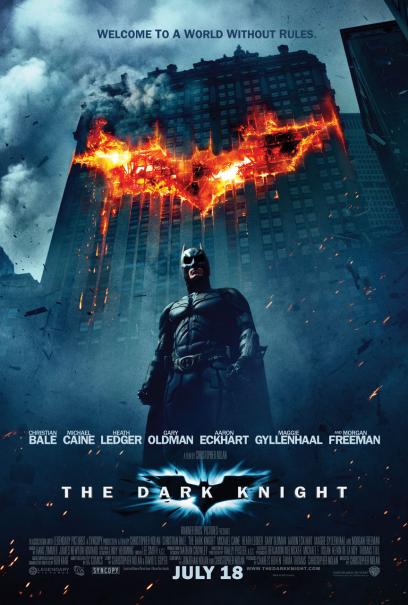
The Dark Knight - IMDb and TV Tropes
It's going to be hard to not turn this into a drooly, adoring speech about the Joker, so I'll just say I think that character is one of the most extraordinary, genuinely frightening villains ever created, and the bar has been set very high by previous adaptations - but The Dark Knight still wins. I've got a slightly sick interest in moral dilemmas within stories, but they only work when they're done well - but The Dark Knight takes the whole Sadistic Choice thing to a whole new level. The pacemaking in this film is superb - it's really one-part superhero movie, and four-parts thriller - I've never known another film take you along for the ride the way this does. Also, someone among the collective screenwriters has some sort of doctorate in Epic Lines - the "Some men just want to watch the world burn" anecdote is inspired.

I have now literally spent about twenty minutes trying to think of something I didn't like about this film, but all I've got is Batman's voice. It's a little bit panto.

*****

The Dark Knight Rises - IMDb and TV Tropes
I think I've decided that this film was my least favourite of the three, but I still thought it was excellent. I particularly appreciated that they took their time bringing Batman back - unlike the standard Superhero Sequel, wherein the hero has one Profound Encounter and whips the mask back out in the first five minutes, it takes ages for Bruce Wayne to turn back into Batman. As an extension of that, I was also pleasantly surprised that they went for realism over Hollywoodism in Batman's first fight scene - he doesn't just get beaten, he gets annihilated in a straight punch-up; no explosions or gadgetry, he just gets the crap kicked out of him because he's simply not as good as he used to be. The intricacy of the plot was very clever - much more reminiscent of what made Inception so brilliant; so confusing it's genius.

That said, though Batman's voice has always been annoying, this time it was easily outdone by Bane - it was like Sean Connery in a Darth Vader mask. There were fewer laughs in this film too - I mean, the laughs in The Dark Knight were mainly slightly-horrified, but this film was taking itself too seriously. I also thought the middle section went on for way too long, and was (and I am aware of the irony as I say this) a bit too far-fetched.
****

Monday, 6 August 2012

Film: The Amazing Spider-Man

It's going to be really hard to talk about The Amazing Spider-Man without comparing it to the Sam Raimi trilogy (of which I think 1 is fine, 2 is better and 3 is just one big fat raspberry), but from my perspective, I don't think that's really going to do the new film much harm. Also, for a proper comparison, this blog does a brilliant breakdown that I almost entirely agree with. Superhero movies are, by nature, treading a dangerous line of cliches, and it's usually very easy to pick the best (Avengers Assemble) from the worst (Hulk). For information: IMDb, for hilarious perceptiveness: TV Tropes.

Before I get into the story aspects, I've got to put it out there that Andrew Garfield - due partly to being just an excellent specimen of human being - is twice the Spider-Man Tobey Maguire was. I think Maguire is a good actor, but he just wasn't right for my idea of Spider-Man; too wet, too dopey and without any sex appeal to speak of (and the guy's wearing a spandex body suit).

But, to the point. I really liked the extra element of humour in the new Spider-Man - I never read the comics, but I used to watch the animated TV show as a kid, and Spider-Man's quippy one-liners were sadly lacking in previous efforts.

Now I've tried for a good ten minutes to think of a word other than 'realistic' to describe what I thought of the plot, but I got nothing. When I say it's 'more realistic' than other superhero movies, I'm trying to explain that I thought the characters were more perceptive, Peter Parker was more flawed and the details of character and story were all surprisingly three-dimensional for a story so not-rooted in realism.

I also have to spare a thought for Emma Stone. I've expressed my love for her before, but seriously guys, Emma Stone is wicked. In terms of her character, I (and my eardrums) seriously appreciated that she took the character of Gwen Stacey beyond the Kirsten Dunst school of 'Be Thrown Around And Scream A Lot'. I tell you what though, I'd really like to see a superhero film in which the girl was the superhero, and boy was the stay-at-homer. Off the top of my head, I can't think of a single girls-superhero film in which the boys weren't also superheroes - can you? (That's not rhetorical - seriously, can you?)

That said, it wasn't perfect. I didn't like the not-infrequent cases of Protagonist Does Something Profoundly Dense To Move The Plot Along - the scene in which Peter gets bitten by the spider was shouting-at-the-screen levels of idiotic.

There were also some classic superhero/action movie cliches, the most eye-rolling example being the 'Before I Die Speech'. That 'Here Are Lots Of Deep And Heartwarming Moments And Now That I've Said Everything Important In A Not-Very-Subtle Poorly-Voice Please Excuse Me While I Die' which gets very:

****

Friday, 27 July 2012

Neverwhere - Neil Gaiman

For a geek, I've come into surprisingly minimal contact with Neil Gaiman, and wasn't that compelled by what I knew of - I thought Stardust (book) was weird, Coraline (film or book) has never appealed to me and his Doctor Who episode was deeply disappointing. That said, I thought the idea behind Neverwhere was so interesting that it was worth trying anyway, and it made me finally understand what all the Neil Gaiman fuss is about.

It's been a good couple of weeks since I finished it, so my memories of it are a touch rustier than I would like, though I tried to refresh them with a goodreads and TV Tropes fest.

The kind of imagination that just pulls a load of creativity from nothing is absolute genius, but I have a soft spot for that other kind of imagination; the one that takes completely ordinary and mundane things and elevates them to a level of Awesome. The more boring and everyday the root, the better the result. The entire concept of London Below is basically Neil Gaiman doing this with a London Tube map.

I love me a good twist, and I particularly love a good ooh-there's-a-traitor-but-who-amongst-the-Motley-Group-is-it? I may simply be losing my touch with predicting twists, but I was completely thrown off Twist Number One by a cleverly-executed red herring, and Twist Number Two came so far out of left field, I hadn't even considered it.

I have a soft spot for Mr-Normal-Everyman-accidentally-lands-in-craziness stories; I once watched a documentary where a very astute person said that all the best tales are about an Ordinary person thrown into an Extraordinary situation, or an Extraordinary person dumped somewhere Ordinary. Neverwhere is a perfect example of the former.

But on to the stuff I didn't like... Psychic dreams. *blows raspberry* Neil Gaiman's subtlety is otherwise way beyond this, but there are a lot of teasers in which various characters have a dream that heavily hints at what may happen later on in the book.

This is kind of clutching at straws, but I prefer bad guys who are evil for a reason, rather than just evil because they are evil. That said, there is a new level of bone-chilling-ness about this particular straight-up evil.

****
(Side-note: this is a thoroughly charming review of Neverwhere which I completely agreed with: http://impossibletosay.wordpress.com/2012/04/29/neil-gaimans-neverwhere-the-reality-of-imagination/)